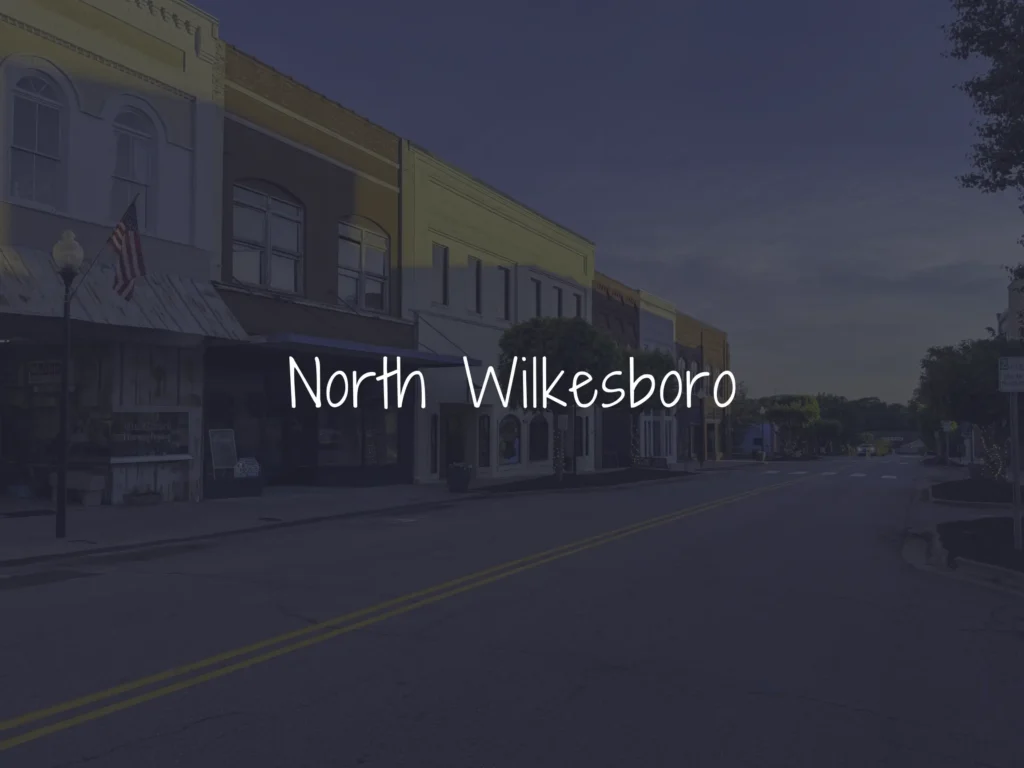
Set in the foothills of the Blue Ridge Mountains in northwestern North Carolina, Wilkes County is one of the most genuinely fascinating counties in the state. With a history that includes Revolutionary War resistance, frontier exploration with Daniel Boone, a hard-earned reputation as the “Moonshine Capital of the World,” the birth of NASCAR, the founding of Lowe’s Companies, and the home of one of the most beloved Americana music festivals in the country, Wilkes County packs more national significance into its rolling hills than its quiet appearance suggests. Today the area is anchored by North Wilkesboro, NC, the county’s largest town and industrial hub, and the county seat of Wilkesboro, NC, just across the Yadkin River, while small communities like Purlear, NC preserve the rural mountain character that has defined the county for centuries. Click on the communities below to dive deeper into the places we’ve personally explored throughout Wilkes County.
A History as Bold as Its Namesake
Wilkes County was established by the North Carolina General Assembly in 1777, with the act taking effect on February 15, 1778. It was formed from Surry County and the District of Washington — a vast frontier territory at the time — and named for John Wilkes (1725-1797), a British radical politician and Lord Mayor of London. Despite never visiting America, Wilkes had become a celebrated champion of American colonial rights, advocating for the freedoms that would lead to the founding of the United States. North Carolina honored him by naming this rugged frontier county in his memory.
The early years of the county were defined by frontier life. Daniel Boone spent time in the region before heading west to settle Kentucky. Wilkes County also became a crucial site of resistance against British forces during the Revolutionary War, with local figures like General William Lenoir and Colonel Benjamin Cleveland leading patriot militias in pivotal mountain engagements. The Civil War touched the county as well, most notably through Stoneman’s Raid in the conflict’s closing months.
Wilkes County is also the setting for one of the most famous folk songs in American history. Tom Dula — known to most listeners as Tom Dooley — was a Confederate veteran from Wilkes County who was hanged in 1868 for the murder of Laura Foster. His story became the basis of the haunting folk ballad, popularized again in 1958 by The Kingston Trio.
The Moonshine Capital and the Birth of NASCAR
By the early 20th century, Wilkes County had earned a reputation as the “Moonshine Capital of the World” — a leading producer of illegal homemade liquor across the country. From the 1920s through the 1950s, the county’s hidden stills and mountain hollows produced “white liquor” that found its way to Detroit, New Jersey, and South Florida.
What makes the moonshine story remarkable isn’t just the scale of the trade — it’s what came out of it. To outrun federal agents and local police on winding mountain roads, moonshine runners modified their cars for speed, handling, and endurance. Those modified cars and the drivers who pushed them to their limits became the foundation of what we now know as stock car racing. The North Wilkesboro Speedway opened in 1947 as the first track ever to host a NASCAR race, with the first NASCAR-sanctioned event held there in October 1949.
Wilkes County native Junior Johnson became one of NASCAR’s earliest superstars — a man who was both a legendary moonshine runner and a Hall of Fame race car driver. His story was immortalized in Tom Wolfe‘s 1965 Esquire article “The Last American Hero Is Junior Johnson. Yes!” and later adapted into the 1973 film The Last American Hero starring Jeff Bridges. Benny Parsons, another NASCAR Hall of Famer, also called Wilkes County home.
Home of Lowe’s Companies and MerleFest
In 1946, Lowe’s Companies — today a Fortune 500 home improvement giant — was founded in downtown North Wilkesboro as a small hardware store. The company has since grown into one of the largest home improvement retailers in the country, and its origins in this corner of the state remain a point of local pride. Tyson Foods, which operates a major chicken processing plant in Wilkesboro, also continues to anchor the local economy.
The other modern cultural anchor in Wilkes County is MerleFest, an annual Americana and folk music festival held on the campus of Wilkes Community College. The festival was founded by the legendary guitarist and singer Doc Watson in memory of his son, Eddy Merle Watson, after Merle’s death in 1985. What began as a small gathering has grown into one of the most beloved music festivals in the country, hosting artists like Willie Nelson, Dolly Parton, Nickel Creek, Alison Krauss, and dozens of others over the years. The festival celebrates bluegrass, old-time, country, Americana, and folk music — a fitting tribute to the region’s deep musical traditions.
A Mountain Outdoor Destination
Beyond its history and culture, Wilkes County is a real outdoor destination. The Yadkin River and Reddies River wind through the county, offering opportunities for fishing, paddling, and riverside recreation. A portion of Stone Mountain State Park — home to the dramatic 600-foot granite dome — sits in western Wilkes County, with the park spanning both Wilkes and neighboring Alleghany County. The county also offers access to hiking trails, scenic drives through the foothills, and dozens of small mountain communities where you can experience the rural character that has defined this part of the state for centuries.
Discover the Communities of Wilkes County
Explore the communities we’ve personally visited in Wilkes County, including the industrial hub of North Wilkesboro, the small mountain community of Purlear, and the county seat of Wilkesboro. Click on the images below to dive deeper into each of these unique towns and communities.